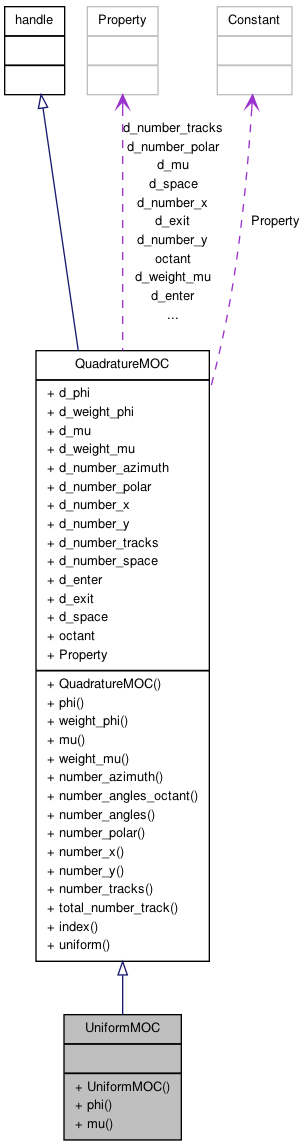
Public Member Functions |
| function | UniformMOC (in number_azimuth, in number_polar, in number_space) |
| function | phi (in obj, in o, in i) |
| function | mu (in obj, in i) |
| function | weight_phi (in obj, in i) |
| function | weight_mu (in obj, in i) |
| function | number_azimuth (in obj) |
| function | number_angles_octant (in obj) |
| function | number_angles (in obj) |
| function | number_polar (in obj) |
| function | number_x (in obj, in m) |
| function | number_y (in obj, in m) |
| function | number_tracks (in obj, in m) |
| function | total_number_track (in obj) |
| function | index (in obj, in o, in a) |
| | Computes cardinal angle index.
|
| function | uniform (in obj, in a, in b, in m, in f) |
Public Attributes |
| Property | d_phi |
| | Azimuthal angles (positive quadrant only)
|
| Property | d_weight_phi |
| | Azimuthal weights.
|
| Property | d_mu |
| | Polar cosines (w/r to the x-y plane)
|
| Property | d_weight_mu |
| | Polar weights.
|
| Property | d_number_azimuth |
| | Number of azimuthal angles.
|
| Property | d_number_polar |
| | Number of polar angles.
|
| Property | d_number_x |
| | Number horizontal intercepts.
|
| Property | d_number_y |
| | Number vertical intercepts.
|
| Property | d_number_tracks |
| Property | d_number_space |
| | Number of tracks.
|
| Property | d_enter |
| Property | d_exit |
| Property | d_space |
| Constant Property | octant = [ 1 1 1 |
| | Octant cosign signs.
|
| Constant | Property |
Uniform azimuthal quadrature.
This quadrature takes a user-defined number of tracks, used for all angles, and a number of azimuthal angles per quadrant. The azimuthal angles are initial uniformly distributed in the first quadrant. This is used to select the number of x and y intercepts for the given angle. These intercepts are distributed evenly on the surfaces. The azimuthal angles are then adjusted to match the x and y intercepts. Note, this means some combinations do not work. If an error about repeated angles arises, the user must choose fewer angles or more spatial points. Generally, for an even number of angles and tracks, the spacing should be about 3 times higher to ensure they don't repeat. For an odd number of angles and track, a factor of 2 plus 1 seems to work.