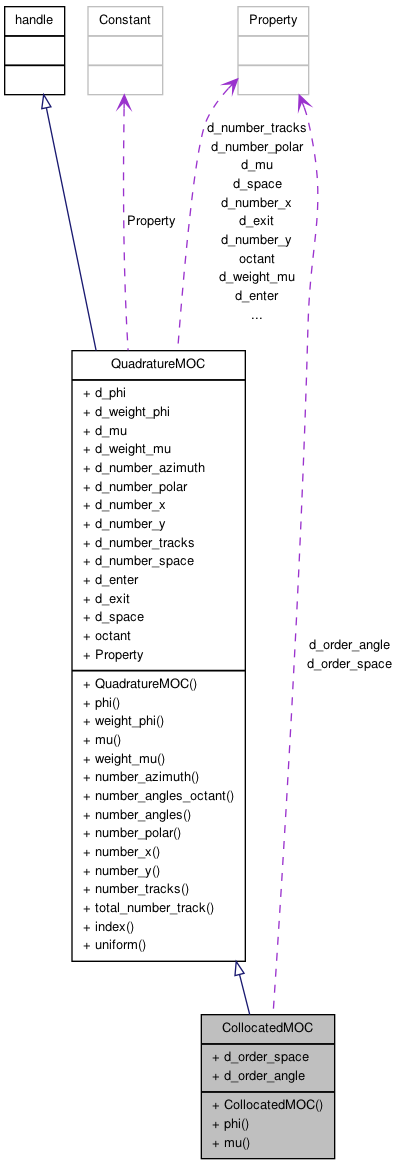
Public Member Functions |
| function | CollocatedMOC (in number_space, in) |
| function | phi (in obj, in o, in i) |
| function | mu (in obj, in i) |
| function | weight_phi (in obj, in i) |
| function | weight_mu (in obj, in i) |
| function | number_azimuth (in obj) |
| function | number_angles_octant (in obj) |
| function | number_angles (in obj) |
| function | number_polar (in obj) |
| function | number_x (in obj, in m) |
| function | number_y (in obj, in m) |
| function | number_tracks (in obj, in m) |
| function | total_number_track (in obj) |
| function | index (in obj, in o, in a) |
| | Computes cardinal angle index.
|
| function | uniform (in obj, in a, in b, in m, in f) |
Public Attributes |
| Property | d_order_space |
| Property | d_order_angle |
| Property | d_phi |
| | Azimuthal angles (positive quadrant only)
|
| Property | d_weight_phi |
| | Azimuthal weights.
|
| Property | d_mu |
| | Polar cosines (w/r to the x-y plane)
|
| Property | d_weight_mu |
| | Polar weights.
|
| Property | d_number_azimuth |
| | Number of azimuthal angles.
|
| Property | d_number_polar |
| | Number of polar angles.
|
| Property | d_number_x |
| | Number horizontal intercepts.
|
| Property | d_number_y |
| | Number vertical intercepts.
|
| Property | d_number_tracks |
| Property | d_number_space |
| | Number of tracks.
|
| Property | d_enter |
| Property | d_exit |
| Property | d_space |
| Constant Property | octant = [ 1 1 1 |
| | Octant cosign signs.
|
| Constant | Property |
Collocated azimuthal quadrature.
This quadrature has a number of unique features. It satisfies cyclic tracking requirements in a rectangular region. It also uses a finite set of points along a surface as track entrance (and exit) points. In first implementation, we consider only square regions.
The user sets the number of spatial points along a side. Currently, this must be a power of 3, and only 9 and 27 are supported.
The angles (between  and
and  ) are uniquely defined by
![\[ \tan{\phi_i} = 3^i \, , \,\,\, i = 0, \, \cdots n \, , \]](form_54.png)
where
![\[ n = \mathrm{floor}(\log_3(N)+1) \, \]](form_55.png)
and N is the number of spatial points. Note that n/N is maximized when N is a power of three. Using 9 spatial points surface yields 5 angles per quadrant. 27 points yields 7 angles per quadrant. The other angles are defined by symmetry about .
For weights, the user can use an arc length approximation or a quadrature rule defined for the points that may provide better accuracy.