Diamond difference approximation for MOC. More...
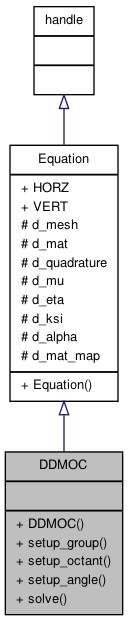
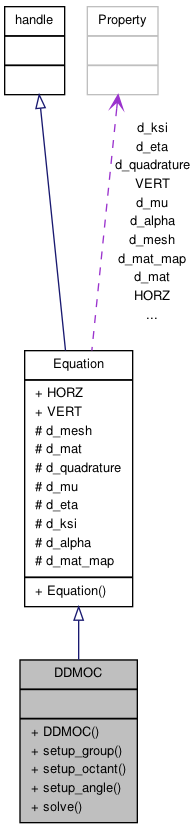
Public Member Functions | |
| function | DDMOC (in mesh, in mat) |
| Class constructor. | |
| function | setup_group (in obj, in group) |
| Setup the equations for a group. | |
| function | setup_octant (in obj, in octant) |
| Setup the equations for an octant. | |
| function | setup_angle (in obj, in phi, in ignoredArg) |
| Setup the equations for an angle. | |
| function | solve (in obj, in psi_in, in s, in sig, in t, in ignoredArg) |
| Solve for the cell-center and outgoing edge fluxes. | |
Public Attributes | |
| Constant Property | HORZ = 1 |
| Constant Property | VERT = 2 |
Protected Attributes | |
| Property | d_mesh |
| Problem mesh. | |
| Property | d_mat |
| Material definitions. | |
| Property | d_quadrature |
| Quadrature. | |
| Property | d_mu |
| Current mu value. | |
| Property | d_eta |
| current eta value | |
| Property | d_ksi |
| Current ksi value. | |
| Property | d_alpha |
| Weighted diamond difference parameter. | |
| Property | d_mat_map |
| Material map. | |
Detailed Description
Diamond difference approximation for MOC.
In the method of characteristics, the flux is solved for along a track assuming a flat source. In the diamond difference approximation, the average segment flux is taken as an average of the incident and and exiting flux. Similar to the step characteristic (SCMOD), we define the outgoing segment flux
![\[ \psi_{out} = A\psi_{in} + B Q \, , \]](form_63.png)
and average segment flux
![\[ \bar{\psi} = \frac{1}{l} \Big ( B \psi_{in} + C Q \Big ) \, , \]](form_64.png)
but now
![\[ A = \frac{2-\tau}{2+\tau} \, , \]](form_65.png)
![\[ B = \frac{2l}{2+\tau} \, , \]](form_66.png)
and
![\[ C = \frac{l^2}{2+\tau} \, , \]](form_67.png)
where  is the segment length and
  is optical path length.
Unlike the step characteristic approximation, the diamond difference approximation is second order in space but is not guaranteed to yield positive fluxes.
Reference: A. Hebert, Applied Reactor Physics.
- See also:
- DDMOC
Constructor & Destructor Documentation
| function DDMOC | ( | in | mesh, |
| in | mat | ||
| ) |
Class constructor.
Set the mesh and material.
- Parameters:
-
mesh Problem mesh. mat Material definitions.
- Returns:
- Instance of the DDMOC class.
Member Function Documentation
| function setup_angle | ( | in | obj, |
| in | phi, | ||
| in | ignoredArg | ||
| ) |
Setup the equations for an angle.
- Parameters:
-
phi Azimuth with respect to x axis.
| function setup_group | ( | in | obj, |
| in | group | ||
| ) |
Setup the equations for a group.
Here, we'll go through the grid and produce a fine mesh matrix of total cross-sections. This isn't the best thing for memory, but it cuts down a lot on the time within solve.
- Parameters:
-
group Current group.
| function setup_octant | ( | in | obj, |
| in | octant | ||
| ) |
Setup the equations for an octant.
- Parameters:
-
octant Current octant.
| function solve | ( | in | obj, |
| in | psi_in, | ||
| in | s, | ||
| in | sig, | ||
| in | t, | ||
| in | ignoredArg | ||
| ) |
Solve for the cell-center and outgoing edge fluxes.
- Parameters:
-
psi_in Incident flux vector s Region isotropic source sig Region total cross-section t Segment length (includes polar scaling)
- Returns:
- Segment exit and average angular flux.
Member Data Documentation
Property d_alpha [protected, inherited] |
Weighted diamond difference parameter.
Property d_eta [protected, inherited] |
current eta value
Property d_ksi [protected, inherited] |
Current ksi value.
Property d_mat [protected, inherited] |
Material definitions.
Property d_mat_map [protected, inherited] |
Material map.
Property d_mesh [protected, inherited] |
Problem mesh.
Property d_mu [protected, inherited] |
Current mu value.
Property d_quadrature [protected, inherited] |
Constant Property HORZ = 1 [inherited] |
Constant Property VERT = 2 [inherited] |
The documentation for this class was generated from the following file:
- /home/robertsj/Research/matlab_transport_pack/source/DDMOC.m